
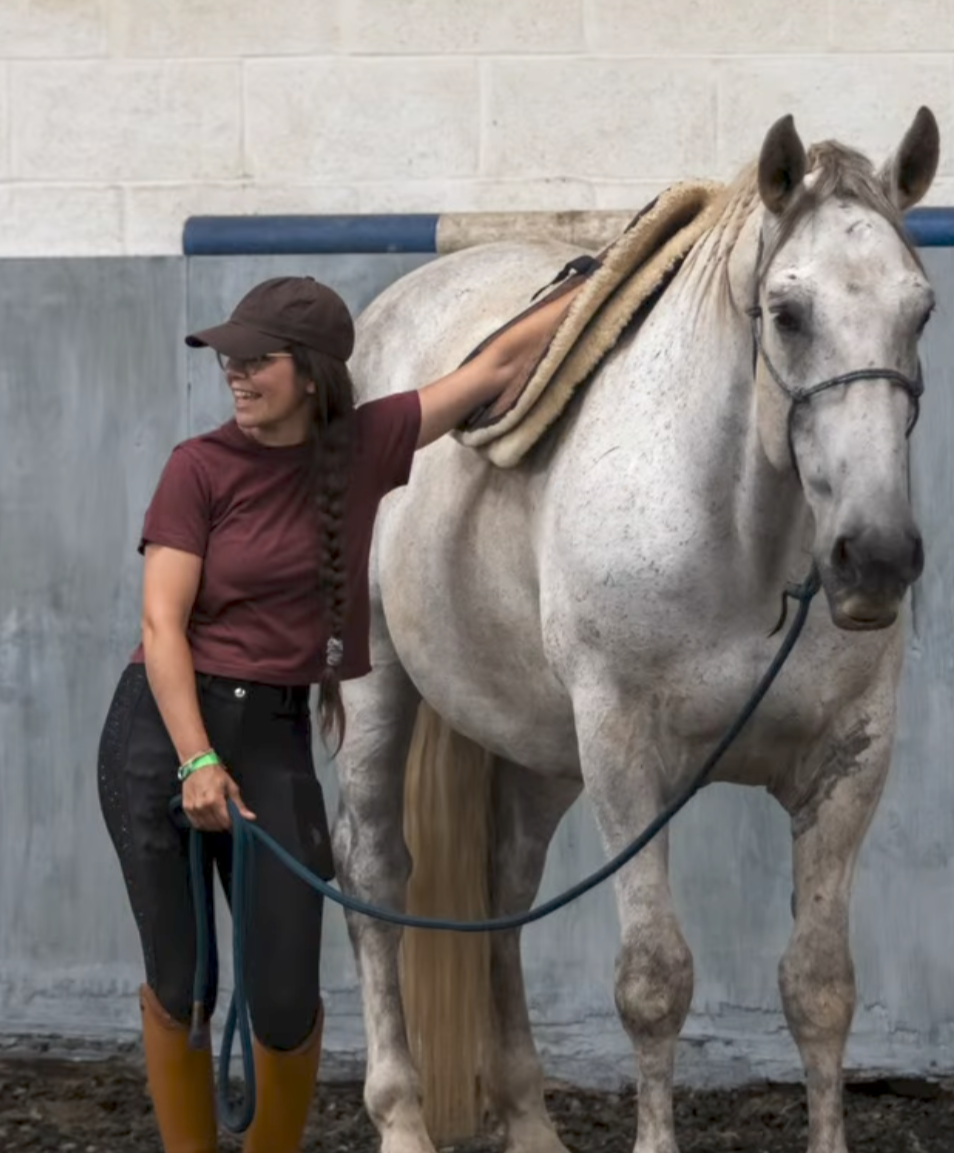
What I Learned at the UK’s First Emotional Horsemanship Clinic
Last weekend I travelled to Northamptonshire to spend two days learning with Lockie Phillips at the first Emotional Horsemanship clinic held in the UK.
I expected it to be interesting.
What I didn’t expect was quite how many connections I would make between his approach to training and what I see every day through my work as an equine osteopath. I came home with plenty of practical exercises. But much more importantly, I came home with a different layer of questions.
Here are the things I am still thinking about.
1. Before changing the response, look at the horse’s relationship with the question
One of the earliest exercises looked deceptively simple.
Clip the lead rope on.
Create a very small amount of contact.
Notice any change.
Release.
At this stage, there may not even be a specific behaviour you are looking for.
Perhaps the horse notices you.
Perhaps an ear changes.
Perhaps their posture changes.
Perhaps there is a tiny shift towards you.
Release.
Then repeat.
Only gradually does the question become more specific.
Perhaps now the release comes for regard.
Later for flexion.
Later for a particular foot.
Eventually for the movement you actually wanted.
Lockie described this as thin-slicing behaviour.
Instead of asking for the completed answer and escalating until you get it, you divide the learning into pieces small enough for the horse to understand.
It also does something deeper.
It starts to rehabilitate the horse’s relationship with pressure and contact.
For many horses, being held, pulled, kicked or repeatedly corrected has made contact something they tolerate rather than understand.
Ideally pressure should mean:
there is information here, and when I find the answer it will go away.
Sometimes we may need to rebuild that conversation before asking for more.
2. Direction is not automatically the opposite of freedom
We did an exercise in which one person guided another.
Once the message became clear, I noticed something surprising.
Being guided was actually relaxing.
I didn’t have to continuously predict what was expected.
I didn’t need endless mental chatter.
I could simply follow the information while still retaining the ability to make my own decision if I needed to.
Lockie described this as mental economy.
I think this adds an important layer to conversations around consent and choice.
Agency matters enormously.
But agency does not necessarily require us to provide no direction.
Sometimes clear, consistent, trustworthy guidance may itself create safety.
The important questions become:
Does the horse understand the signal?
Does the signal reliably disappear when they respond?
Am I using the minimum information necessary?
Is the horse becoming clearer or more confused
3. Learning requires a moment of uncertainty
Whenever we ask something genuinely new, the horse cannot already know the answer.
There has to be a little moment of:
“What?”
That uncertainty isn’t automatically a problem.
But the horse needs enough confidence to remain curious while working through it.
One simple imagined conversation from the weekend has really stuck with me:
Horse: “I’m unsure.”
Human: “I know.”
Not dismissing the uncertainty. Not becoming frightened of it either.
Helping the horse find their way through it.
There is a difference between forcing a horse through fear and supporting a horse through uncertainty.
That middle ground interests me enormously.
4. Sometimes what looks like a boundary is actually a lack of confidence
One discussion touched on the risk of accidentally using very soft techniques to avoid harder conversations.
Sometimes a horse genuinely does not consent.
Sometimes the answer should absolutely be no.
But sometimes what we are seeing is:
“I’m not confident enough to try.”
Those are not necessarily the same thing.
A horse may need us to acknowledge their uncertainty while also making the task understandable enough for them to discover that they can do it.
Kindness is not always avoidance.
Sometimes kindness is helping another being discover their own competence.
5. Our body position changes the emotional meaning of movement
One exercise looked at the spatial relationship between mare and foal.
A mare may position herself along the inside of a curve around her foal, effectively creating a protective boundary between the youngster and the outside world.
Lockie used a similar positioning when helping horses that needed greater confidence.
Rather than always being outside the horse driving them into movement, our own body can sometimes communicate:
I am here. I’m containing the outside space.
I found this particularly interesting because it reminds us that our body is communicating long before we pull a rope or apply a leg.
Where we stand matters.
How we move matters.
What our posture predicts matters.
6. A “space invader” may be asking a different question than we think
Another little phrase I loved came up around horses that continually move into the handler’s space. We often label these horses pushy or disrespectful.
Lockie reframed one possible interpretation as:
“I don’t know how to get close to you.”
That stopped me.
The behaviour still needs addressing. Personal space still matters. But the interpretation changes how we teach. Instead of simply pushing the horse away harder, could we teach them another way of maintaining connection with us?
Behaviour becomes information rather than a character judgement.
7. Stop trying to fix “napping”
The discussion around napping was another example. Instead of asking:
“What technique will stop my horse napping?” start asking better questions.
Does the horse have enough confidence to leave home?
Do they trust the rider or handler?
Are their feet comfortable?
Is the tack comfortable?
Are they physically fit enough?
What has hacking historically meant for this horse?
Does leaving the yard predict a pleasant forty-minute wander or a three-hour ordeal?
Suddenly “napping” is no longer the diagnosis. It is the symptom.
This feels very familiar to me as an osteopath. Finding the painful structure isn’t usually where my investigation ends. I want to know:
Why did it become overloaded?
We can apply exactly the same curiosity to behaviour. “Lazy”, “strong”, “stubborn”, “nappy”, “won’t bend” and “falls in” are descriptions. They are not necessarily explanations.
8. Does the horse physically have the answer available?
This was perhaps where the clinic met my osteopathic brain most strongly. We went onto all fours and experienced loading approximately 70% of our bodyweight forwards while allowing the shoulders to collapse. Then we shifted the weight backwards and created lift through the shoulder girdle. The change was immediate.
A horse can understand perfectly what we are asking and still not have the physical strength, balance or coordination to provide the answer well. This is enormously important.
Before asking:
“Why won’t my horse carry themselves?”
we sometimes need to ask:
“Can my horse carry themselves yet?”
9. Don’t manufacture the head before the body exists underneath it
One ridden conversation particularly resonated with me. If the shoulder is falling in, don’t necessarily begin by trying to place the nose. Straighten the horse. Strengthen the shoulder. Allow the head and neck to be where they currently need to be. As the body becomes more capable, the outline can begin to emerge from better function.
This is very close to my own philosophy. An outline should ideally be an expression of the way the horse is using the body, rather than a shape we impose on it.
10. Feel the ribcage, not just the feet
We spent time exploring the swing of the ribcage in walk. A small change in tempo. Organising our own elbows underneath our shoulders. Feeling the movement through the horse. Finding a period of better quality. Then opening the walk and releasing. It highlighted the difference between simply producing more movement and producing better movement. And importantly, this does not have to happen exclusively inside an arena. Much of it can be explored while hacking.
11. The release is not what happens after the training
One of the strongest themes throughout the weekend was: the letting go matters. Find a few good strides. Release. Ask. Release. Improve the quality. Then open the walk. The release is not merely a reward added after the “real” work. It forms part of the information. The horse learns not only what effort feels like, but also when effort is no longer required.
12. Don’t ask for impulse, direction and positioning all at once
This was one of the simplest pieces of advice and probably one of the most useful.
Don’t simultaneously train:
impulse,
direction,
and positioning.
Work on one → consolidate it → then add the next piece.
Eventually stack them together.
Think how often we ask a horse to go forward, stay straight, bend, maintain rhythm, carry themselves and perform a movement all at the same time. Then something deteriorates and we simply make the aids bigger. Breaking things down allows us to discover which part of the puzzle the horse actually doesn’t understand or cannot physically maintain.
13. Twenty minutes can tell you a lot
Another practical suggestion: Set a twenty-minute timer.
If after twenty minutes the horse is not thinking differently, consider abandoning that approach. That does not mean the problem must be solved within twenty minutes, it means endlessly rehearsing misunderstanding is unlikely to create understanding. For horses that dislike arena work, Lockie also suggested working in useful chunks. Do something meaningful. Leave. Come back later. Make your point. Don’t overcook it.
14. A horse doesn’t have to “love school” for useful training to happen
This connected nicely with the idea of taking work outside the arena. Ribcage work, tempo changes, strengthening, transitions and short periods of better-quality movement can all happen on a hack. For some horses, that may be far more emotionally useful than repeatedly drilling the same exercise in an environment they already dislike. Again, the question becomes: What does this individual horse need?
15. Trot can be built rather than demanded
There was also interesting discussion around trot, particularly in horses lacking strength through the back and shoulders. Rather than immediately demanding a beautifully organised seated trot, using a light or two-point position can reduce the rider’s direct loading while the horse develops strength and coordination. What I took from this was not that there is one magical way to trot. It was the broader principle:
Don’t demand the finished movement before the body has developed the tools to produce it, give the body a route towards it.
16. Ask the horse about the tack
I also liked a very simple way of checking how the horse feels about being ridden:
- Present the pad. Let the horse investigate it. Observe.
- Remove it when the interaction finishes.
- Present again. Double-check.
- Then gradually bring it towards the body.
The same can be done with the saddle.
Again, the point wasn’t to create an eighteen-stage pre-riding ritual. In fact, Lockie was equally clear that once the horse has given you a genuine yes, don’t keep asking until you have talked them out of it.
At the mounting block: Check in. If the horse says yes, get on.
Don’t miss your moment.
He described it as: taking the pulse of the relationship before proceeding. You don’t necessarily need to perform a formal assessment every single time but sometimes it is worth checking.
17. The horse’s needs are not interruptions to training
This perhaps deserves its own section because it impressed me so much. Throughout the clinic, hay and water were available. If a horse needed a break, the horse had a break. During one individual session, another horse was brought in simply because the horse working benefited from emotional support.
Food rewards were welcome.
Scratches were welcome.
A good bum scratch after effort was absolutely legitimate payment.
What I loved was how unremarkable all of this was made to feel. Nobody stopped the clinic to congratulate themselves for being horse-centred. The horse simply got what they needed. The horse’s welfare was not something fitted around the training.
It was integrated into the training.
18. Horse-first does not have to mean human-last
This might be one of my favourite things about the weekend. There are spaces within horse welfare where compassion for the horse can unintentionally turn into hostility towards the human. That wasn’t what I experienced. The horses were taken seriously.
So were the people. There was no shaming. There was humour.
There was room to get things wrong. Lockie guided far more than he micromanaged. The person was trusted to learn to observe their own horse. The horse wasn’t treated as a problem but neither was the human. The horse-human pair was the partnership being supported. That is exactly the kind of learning environment in which I personally thrive.
19. The rider has a body too
We also explored how our own posture changes what the horse experiences. Walking while bearing down. Then walking while lifting and taking all of ourselves with us. Using our body almost like a sail catching the wind. There was discussion around moving away from defaulting to the heel — a hard structure at the end of a long lever — and gradually refining communication through the thigh, calf, pelvis and waist.
As an osteopath, this matters enormously.
You cannot meaningfully discuss the ridden horse’s ribcage, back, shoulders or thoracic sling while pretending the body sitting on top has no influence. This isn’t about blaming riders. It is about recognising that two bodies are creating one movement together.
20. Not every difficult expression means stop but it does mean observe
There was also useful nuance around expressions such as ears being back. A horse working close to the edge of their balance, strength or concentration may occasionally show that something is difficult. The answer is not to ignore it. But it is not necessarily to panic either. The skill is learning where that individual horse’s edge actually is. Professionals need to become good at recognising it. Guardians gradually learn the same thing about their own horses. We need observation rather than assumptions in either direction.
21. Consistency at home matters more than brilliance in a clinic
One point Lockie made felt particularly relevant to my own work. The real effect is what happens after the clinic. A skilled trainer may help a horse find something wonderful for forty minutes. But what shapes the horse is what is repeatedly experienced afterwards. The same applies to osteopathy. I can change movement during a session. But the horse then returns to their feet, field, tack, rider, diet, movement habits and training.
The life between the sessions creates the horse.
That may be one of the most important principles of all.
22. Good teachers should make us less dependent on them
This was something I noticed almost immediately.
Lockie did not seem interested in making people believe they could only do the work correctly under his supervision. He gave people tools. He gave parameters. Then he trusted them to learn to read their horse. That continued right through to his attitude towards the group afterwards. When an attendees’ WhatsApp group was discussed, he was very clear that he shouldn’t really have anything to do with it. Why? Because this was not supposed to become guru worship. That made me respect him considerably more…
23. “Perfection is fake news”
Lockie openly acknowledged that he has seen things in other parts of the horse world that he personally wouldn’t necessarily choose, while also recognising that some of the humans and horses involved appeared perfectly happy.
There are happy horses and happy people scattered across the horse world.
There is no monolithic solution. Or, in Lockie’s much better wording:
“Perfection is fake news.”
I think the equestrian world desperately needs more of that humility.
Any methodology becomes dangerous when protecting the methodology matters more than observing the horse.
So what will actually change in my own work?
I am not coming home and replacing osteopathy with Emotional Horsemanship. Nor am I going to turn every appointment into a groundwork lesson. The change is subtler. There is simply another layer to the questions I will ask. When a horse struggles with movement:
Where is the biomechanical limitation?
But also: What does this movement mean to this horse?
When a horse braces: Is this pain? Weakness? Anticipation? Uncertainty? Confusion?
Or several simultaneously?
When a horse reacts to contact:
Is the problem the amount of pressure, or what that pressure has historically predicted?
When something isn’t improving: Am I asking too many questions at once?
When I meet hesitation: Is this a no, or an “I’m unsure”?
And before progressing: Have I taken the pulse of the relationship?
I think those questions will make me a better practitioner. And perhaps that is my biggest takeaway from the weekend. The best teachers do not always give us more answers. Sometimes they improve the quality of our questions. And underneath all the biomechanics, learning theory, pressure, release, confidence and communication was something much simpler.
Lockie’s three-step training programme:
Step 1: Love your pony.
Step 2: Love your pony.
Step 3: Love your pony.
Then apparently we just add the details.
Not a bad place to start.
