Emotional Horsemanship
When the Method Isn’t the Point: Two Days with Lockie Phillips
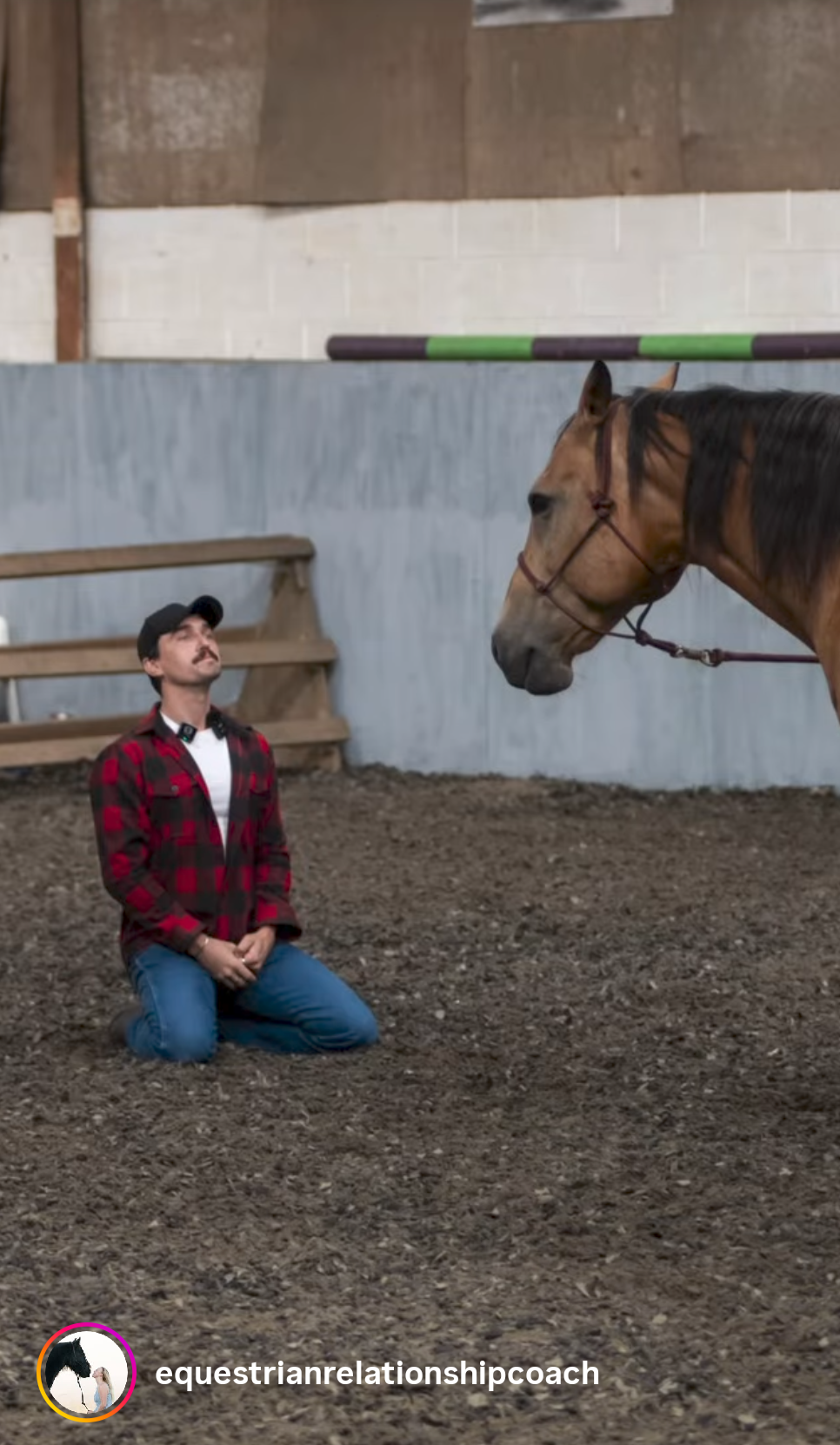
Last weekend I attended what was, rather excitingly, the first Emotional Horsemanship clinic in the UK with Lockie Phillips organised by Cat at Equestrian Relationship Coach and the NLE centre.
I had followed enough of Lockie’s work beforehand to know I was interested. I expected to come home with some new exercises, some different ways of looking at training and probably a few ideas to add to my existing toolbox. I did. But that wasn’t really what stayed with me. What stayed with me was the way he taught, the way he observed, the way he changed his mind, the way the horses were allowed to be individuals, and perhaps most of all, the complete absence of any sense that we were being introduced to The Answer.
First impressions
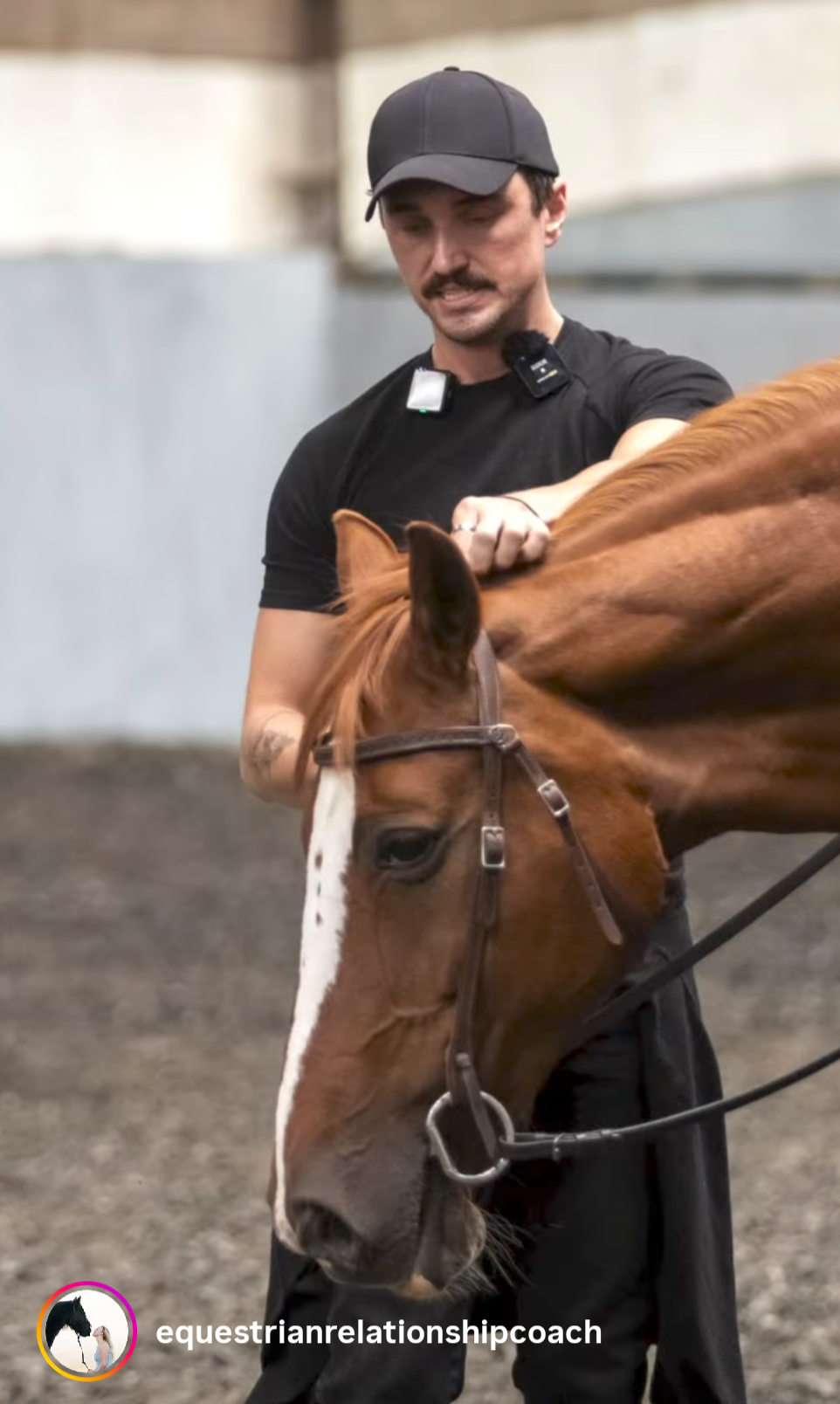
Firstly, he is considerably taller than I expected!
He has also grown a moustache that, at first glance, gives slight “long-lost Jim Masterson brother” energy.
But don’t be fooled. He moves like the ballet dancer that he is: tall, elegant, incredibly light through his own body, somehow looking as though he might pirouette at any moment as he moves between the horses. He is quietly charismatic, very funny, self-aware, empathetic and wonderfully conscious of the occasional absurdity of the horse world and the strange little bubbles we create within it. But one of the qualities that impressed me most was his willingness to say: “I was wrong.”
There was no attachment to appearing infallible. He might suggest something, watch the horse, see a different response than expected and immediately reassess. Not defend the technique. Not blame the horse. Not explain why it should have worked.
Just: Interesting. That isn’t what I thought was happening. Let’s look again.
That, for me, creates trust very quickly.
He trusted the humans too
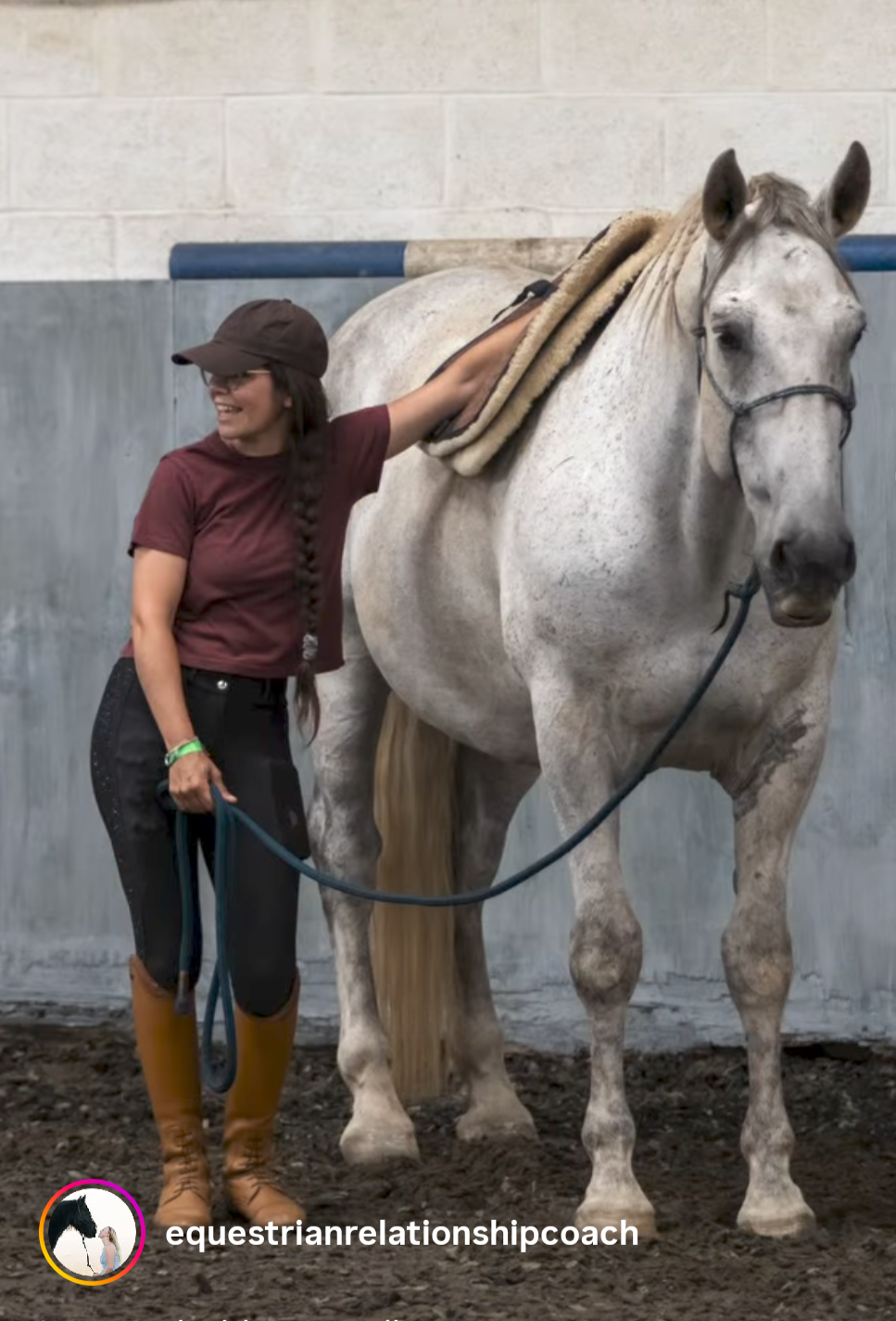
Something I noticed within the first morning was how little he micromanaged people. He gave parameters. He demonstrated. He explained what he might be looking for. Then he allowed people to work things out with their horse. There was an underlying assumption that, given enough information and encouragement, the person standing there was capable of observing their own horse and making sensible decisions. That sounds obvious, but it isn’t always how teaching works. Some systems can leave people feeling increasingly dependent on the expert: the technique becomes something you can apparently use yourself, but somehow you still need constant outside interpretation to know whether you are doing it correctly. This felt very different. Lockie seemed to be trying to make people more capable without him, not more dependent on him. And that thread continued throughout the weekend. There was a methodology, certainly. But the methodology was never more important than the horse standing in front of us.
Pressure was not treated as the enemy
One of the most interesting things for me was the nuance around pressure. There is an understandable movement in modern horsemanship towards consent, choice and reducing coercion. I very much share the concerns behind that. But conversations around pressure can sometimes become rather binary:
pressure = bad
freedom = good.
What I saw was much more interesting. Lockie talked about rehabilitating the horse’s relationship with pressure and contact. At the beginning, you might clip on the lead rope, create the smallest presence through it and release for virtually any change at all. Not because you have already decided what behaviour you want. Perhaps the horse simply notices. Perhaps an ear moves. Perhaps their attention changes. Perhaps there is the beginning of flexion. Release. Then repeat. Only later do you begin to make the criteria more specific. Perhaps now you release for regard. Later for flexion. Later for the placement of a foot. Eventually for a step or a particular movement. He described this as thin-slicing behaviour.
Rather than presenting the horse with the finished answer and escalating until they produce it, you make the question small enough for them to understand how the conversation works. That made me think about how many horses have developed a fairly poor relationship with being directed by humans. Contact has not necessarily meant:
There is some information here. Find the answer and it will disappear.
Sometimes it has meant:
Something has started happening to me and I’m not entirely sure when it stops.
Before teaching another response, perhaps sometimes we need to clean up the horse’s relationship with being asked in the first place.
Clear guidance can actually feel good
One of the human exercises gave me an insight I wasn’t expecting. We experienced being guided by another person. Once the communication was clear, I found being guided surprisingly relaxing. I didn’t have to constantly predict. I didn’t need endless mental chatter. The message was understandable, so I could simply allow myself to follow it while still retaining the ability to think and make a different decision if I needed to. Lockie described this as mental economy. That has really stayed with me. Because maybe good horsemanship is not about removing all influence, direction or expectation. Maybe it is about becoming sufficiently clear, consistent and trustworthy that being guided does not require the horse to constantly guess. Freedom is not necessarily the absence of direction. Sometimes clarity itself creates safety.
“I’m unsure.”
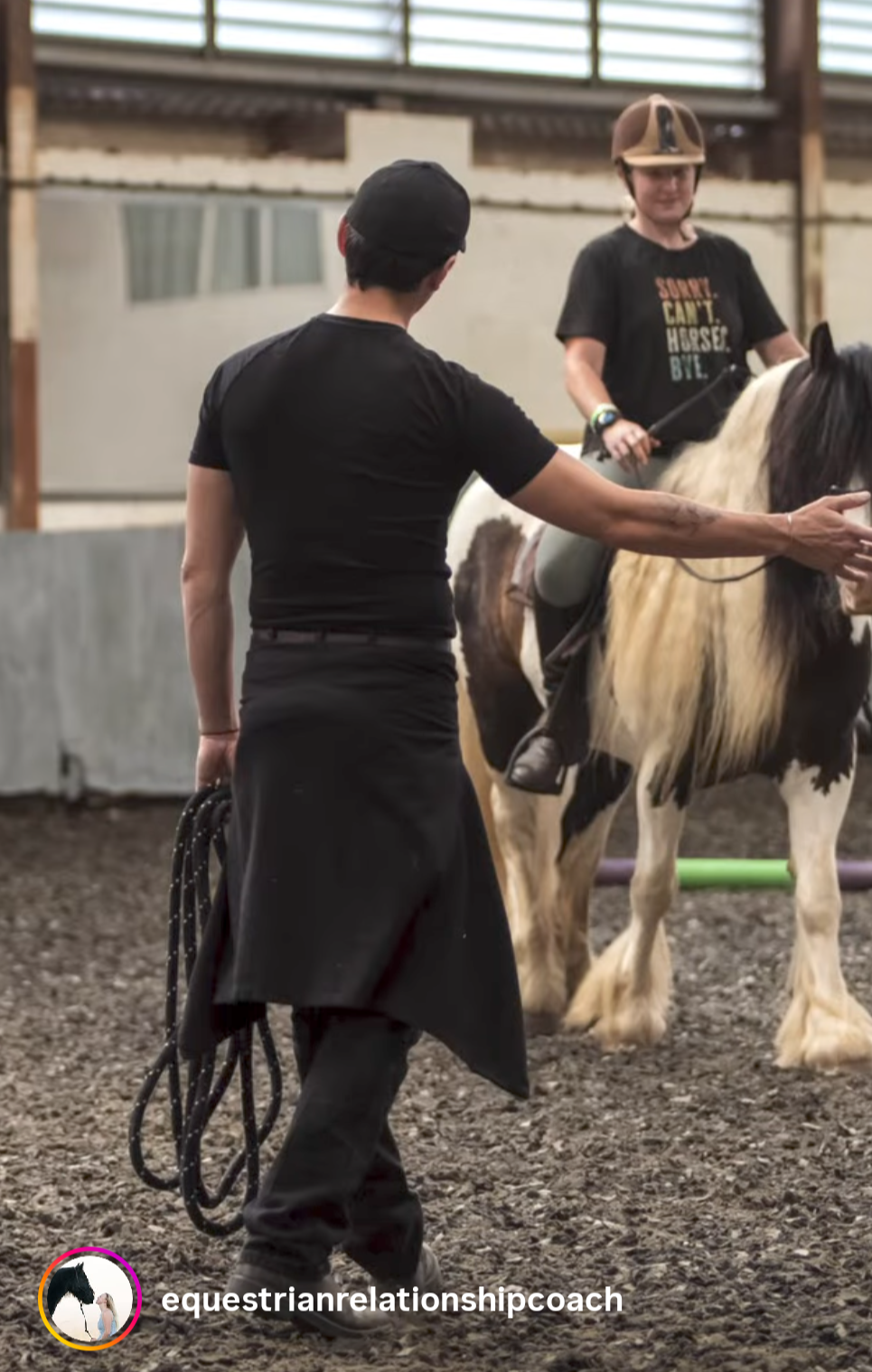
Another moment that stayed with me was the discussion around uncertainty. When we ask a horse something genuinely new, something they were not predicting, there has to be a moment in which they do not yet know the answer. All learning contains a little moment of: What? That uncertainty requires confidence.
And hesitation does not always mean: “No.”
Sometimes it means: “I’m unsure.”
Our response does not have to be: Fine, we will never ask again. Nor does it have to be: You WILL do this. There is a much more interesting middle ground: “I know you’re unsure. I’m still here. Let’s work it out.” That distinction feels important to me. Kindness does not always mean avoiding difficult conversations. Sometimes kindness is making the difficult conversation small enough, clear enough and safe enough that the horse discovers that they can do it.
The clinic itself was horse-first
And maybe what impressed me most was that none of this remained theoretical: Lockie very clearly talks the talk and walks the walk. Hay and water were available to the horses throughout. If a horse needed to stop and eat, that was not treated as a disruption to the lesson. If a horse needed a break, it had one. During one of the individual sessions, another horse was brought in simply to provide emotional support because that particular horse benefited from having company. If a horse wanted food rewards after an effort, wonderful. If scratches were the preferred currency, especially a good bum scratch, that was happily provided too. None of this was theatrical. Nobody announced: LOOK HOW HORSE-CENTRED WE ARE!
It was simply built into the environment. The horse’s needs were not an inconvenience to the training: Meeting those needs was part of the training.
And importantly, being horse-first did not mean being anti-human, the humans were met with enormous empathy too. There was humour. There was no shaming. Nobody was made to feel stupid for having got something wrong. There was no performance of superior knowledge. The horse was not treated as a problem. But neither was the person. The horse-human partnership remained the thing being supported. That was incredibly refreshing and exactly how I would like to be taught.
The mother and foal curve
One exercise I found particularly beautiful looked at the spatial relationship between mare and foal. A mare will often position herself on the outside of a curve around her foal, creating something of a protective wall between the youngster and the outside world. Lockie used that spatial relationship when working with horses that needed confidence. Not because we are pretending to be the horse’s mother, but because our position, relative to the horse, changes the emotional meaning of movement. Instead of always driving from the inside, could we occasionally offer the horse the feeling of: I am here, between you and the thing you are unsure about. It made what might otherwise have been “just another groundwork pattern” feel much more meaningful.
Different horses, same principles, different answers
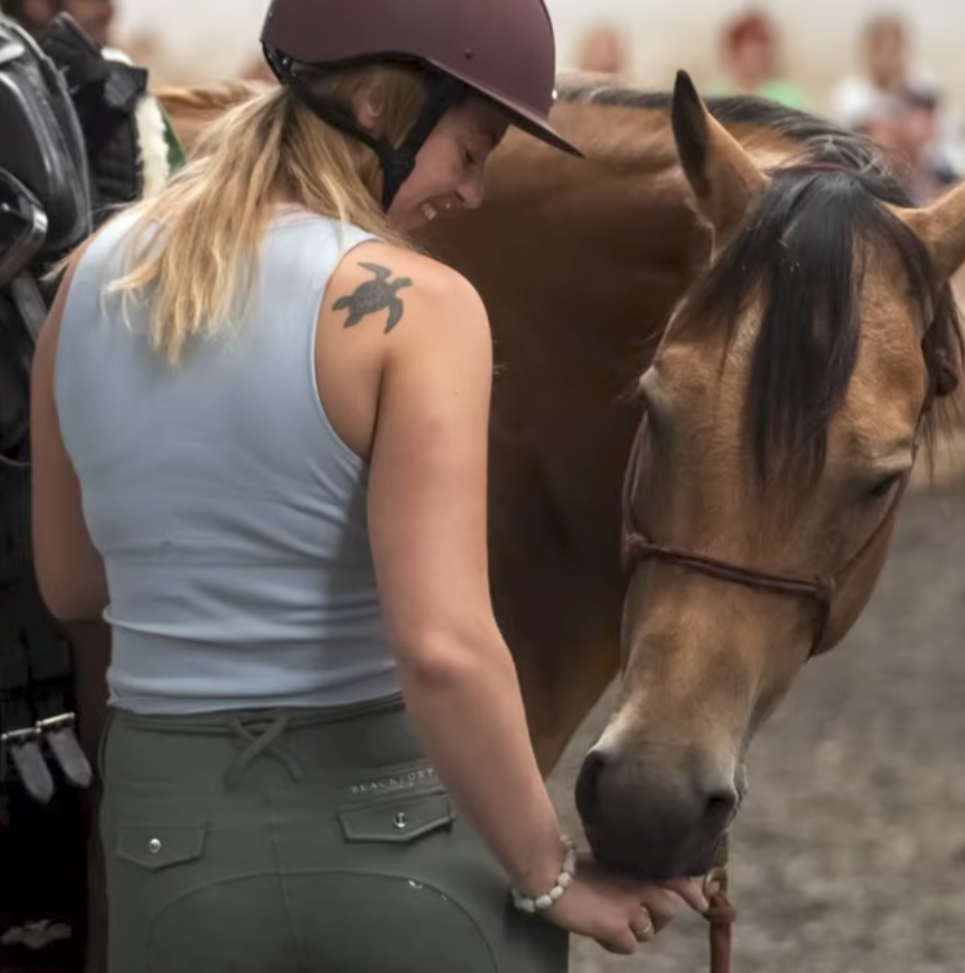
During the first demonstration there were five very different horses in the arena: Different breeds, different personalities, different histories, different responses. And it was fascinating watching the same broad principles change shape depending on who was standing in front of Lockie. Some horses needed more release. Some needed a little more clarity. Some needed to move. Some needed pauses. Some needed confidence. Some needed the exercise modified.
There was enough structure to provide direction, but enough flexibility for the structure to bend around the individual. The horse never had to become an “Emotional Horsemanship horse” in order for the method to work.
I loved that.
Stop trying to solve “napping”
At the Q&A I brought up a question that resonated strongly with me and many of my clients. It was around napping.
My question was “What technique stops a horse napping?” His answer instead was that the behaviour became a source of questioning:
Does the horse have enough confidence to leave the yard?
Does the horse trust the person accompanying them?
Are their feet comfortable?
Is the tack comfortable?
Are they physically prepared?
Does the horse think leaving home means a three-hour expedition?
What does hacking predict for this individual?
Suddenly “napping” stops being the diagnosis. It becomes information. That way of thinking is extremely close to the way I approach osteopathy. Finding the painful structure is rarely where my curiosity ends. I want to know: Why did that structure become overloadedto produce that symptom? Behaviour deserves the same curiosity. Lazy, strong, stubborn, nappy, won’t bend, falls in…Those are descriptions, they are not necessarily explanations.
Then there was the body
This was not horsemanship in which emotion was somehow separated from biomechanics and this is probably where it intersected most strongly with my own work. At one point we got down onto all fours and experienced what it felt like to place around 70% of our weight forwards and collapse between our shoulders. Then we shifted backwards and created lift through the shoulder girdle.
The difference was striking.
There were repeated conversations about the ribcage, thoracic sling, psoas, shoulders but also tempo, spinal movement and quality of gait. One ridden principle particularly resonated with me: Don’t obsess about correcting the nose while the body underneath it is still falling apart. If the horse is falling through the shoulder, straighten and strengthen the shoulder. Let the head and neck be where the horse needs them while the body learns to support itself differently. Eventually, the “correct” position can emerge from better function. That is completely aligned with how I think. An outline should ideally be an expression of how the body is functioning, not a shape imposed upon it. This allowed me to connect a few dots from a different trainer since it aligns with Chris Irwin’s observation that movement should come from the back of the horse to the front in order to integrate within the body with relaxation. Whereas a movement from the front to the back of the horse leads to the horse “percolating with adrenaline“ .
Quality, then release
We spent time feeling the swing of the ribcage in walk, finding a little more quality, slowing the tempo slightly, organising the rider’s body, feeling the swing. Then opening the walk and releasing. What I liked enormously was that the release was not treated as something that happened after the exercise. The release was part of the exercise.
Find several good strides.
Release.
Find them again.
Release.
Contrast can teach without endlessly increasing the strength of the aid and importantly, much of this could be done out hacking. Training did not have to live inside a rectangle.
Don’t ask for everything at once
Another simple piece of advice: Don’t work on impulse, direction and positioning simultaneously.
Work on one. Consolidate it. Then add another. Stack the pieces. It sounds so obvious and yet how often do we ride down the school asking the horse to go forwards, stay straight, bend, maintain tempo, hold an outline, carry themselves and perform a movement all at the same time? Then one part deteriorates and we increase the aids. Breaking the movement down lets us discover which piece the horse actually doesn’t understand or cannot physically maintain.
If nothing is changing, change the conversation
Another wonderfully pragmatic suggestion was to set a twenty-minute timer. If after twenty minutes the horse is not thinking differently, abandon ship. Not because we are giving up on the horse. But because endlessly repeating a conversation that is producing no greater understanding is unlikely to magically become good training.
Similarly, for horses that dislike arena work: Do a useful chunk. Leave. Come back later. Make your point. Don’t overcook it.
Again, it felt very far removed from the idea that success is measured by how long you can keep the horse doing the exercise.
The rider isn’t exempt
We explored our own bodies too. How we walk, bearing down versus lifting, carrying all of ourselves with us ( I liked this one!), the image was almost like a sail catching the wind.
There was discussion around using the thigh, calf, pelvis and eventually even the waist rather than defaulting to the heel as the primary means of communication. As an osteopath, I find this hugely important. You cannot meaningfully discuss what is happening through a ridden horse’s back, ribcage or thoracic sling without eventually discussing the body sitting on top of it.
Not because we need to blame riders. Because two bodies are creating one movement together. Our fascias momentarily merge with one another.
There is an edge
I also appreciated the nuance around expressions such as ears being back. It is very easy in either direction to become simplistic. Some people ignore every expression of discomfort. Others interpret any moment of tension as evidence that the horse must stop immediately. Lockie acknowledged that a horse working close to the edge of its balance or concentration may occasionally look as though it is working hard. The skill is knowing that individual horse. As a professional, learning where the edge is. As a guardian, gradually learning your own horse’s edge. Not ignoring them. Not catastrophising them. Observing. Again.
“Perfection is fake news”
Perhaps the part that made me trust the whole weekend most was Lockie’s lack of interest in creating followers. When the attendees discussed setting up a WhatsApp group, his response was essentially that he should have nothing to do with it.
Because this wasn’t supposed to become guru worship. He spoke openly about seeing things elsewhere in the horse world that he might personally question, while also acknowledging that the horses and humans involved sometimes seemed perfectly happy.
There are happy horses and happy humans across very different parts of the equestrian landscape. As Lockie put it: “There is no monolithic solution” and “Perfection is fake news.”
I think we need much more of that humility in the horse world. Any methodology becomes dangerous when protecting the methodology becomes more important than observing the horse.
What did I actually come home with?
Yes, I came home with exercises. Different ways of working with contact. Ways to use curves and drawing. Ideas around trot. Ways to look at the ribcage. Different ways to assess how a horse feels about being tacked up or mounted. But those were not the most valuable things. I came home with better questions.
How does this horse experience being directed?
What does contact predict for them?
Is this refusal, or uncertainty?
Does the horse understand the question?
Does the body have the physical capacity to provide the answer?
Am I asking several things simultaneously?
Am I helping the horse develop confidence, or simply avoiding the difficult conversation?
When did I last release?
And have I taken the pulse of the relationship before proceeding?
I didn’t come home converted to a method and maybe that would miss the point entirely. I came home expanded. For two days I watched someone create the sort of learning environment I believe horses - and humans - deserve: Serious without being solemn, clear without being authoritarian, light-hearted without being frivolous, horse-first without being anti-human and structured without ever forgetting the individual.
And finally, at the end, Lockie summed up his training programme rather beautifully:
Step 1: Love your pony.
Step 2: Love your pony.
Step 3: Love your pony.
Then we just add the details.
I think that is probably a very good place to start.
Would you like the deeper practical takeaways?
In Issue No. 23 of the Wild Voice Newsletter, I’ll be sharing more of the lessons I’m bringing into my work: From pressure and release and mental economy to the influence of the rider’s body and what these ideas might mean for you and your horse.
To find out more about Lockie’s work, please visit his website https://emotionalhorsemanship.com/