Cody’s Headshaking Journey: A Whole-Horse Case Study
Headshaking is rarely a simple problem. It can involve sensory irritation, environmental triggers, pain, movement patterns and wider mechanical compensation. Cody’s story is a good example of why I prefer to look at the whole horse while working alongside veterinary care.
Cody is a 16-year-old Quarter Horse with a long history of headshaking. His signs had typically been most troublesome in spring and autumn, with September and October often his most difficult months. His owner had seen nose rubbing, head flicking and facial twitching, and wind appeared to be one of his triggers.
A complex history
Cody had experienced significant head trauma and falls in the past. He had already undergone veterinary investigation, including scoping and sinus-related assessment, and had tried medication including anti-inflammatory or analgesic treatment and steroids. Management had included a nose net, UV mask and a ceramic ear mask for windy conditions.
There are many potential causes and contributors to headshaking. In Cody’s case, the working differentials included trigeminal-mediated headshaking, allergy or irritation, dental or sinus disease, ocular or ear irritation, gastric discomfort, tack and contact effects, and mechanical relationships involving the cranium, jaw, hyoid and cervical spine. Osteopathy does not replace veterinary diagnosis, so the aim was not to declare one cause. It was to identify and address functional restrictions that might be adding to his overall load.
The first session
At Cody’s initial assessment on 8 August 2026, I found marked congestion and tension through the upper neck and cranial regions. There were also restrictions through the cervical, thoracolumbar, lumbar and pelvic regions, alongside a hindlimb cuboid restriction.
Treatment included gentle cranial work around the relationships between the temporal and occipital regions, the cranial membranes and drainage patterns. I also addressed compensatory restrictions through the spine, pelvis and hindquarters, as well as relevant visceral and gelding-related tissue relationships.
After the session, Cody had two days off before gradually returning to work. His owner was asked to monitor both the small, spontaneous signs—such as nasal flicks, snorting and rubbing—and the larger head-and-neck movements that might appear with riding, contact or loading.
A striking change by the second visit
When I returned on 23 September, Cody’s owner reported virtually no headshaking signs, despite this normally being the beginning of his worst season. She had not observed nose rubbing, head flicking or facial twitching.
The ceramic ear mask had been needed only once, on a very windy day. Most interestingly, the signs stopped as soon as the mask was fitted. Historically, once an episode had begun, fitting the mask would not stop it. His upper-neck tension had also reduced enough for his owner to introduce more in-hand work asking him to lengthen and stretch his neck.
The pattern I found at reassessment was almost completely different from the first session. Cranial tension was still present, but substantially reduced rather than simply returning in the same distribution.
What I found at reassessment
Cody’s first cervical vertebra was rotated to the right, reducing space between the left wing of C1 and the mandible. Right side-bending through the poll and upper neck was restricted, which corresponded with his difficulty working on the right rein. The left temporal and jaw region were involved in the same compensatory pattern.
Treatment focused particularly on the left temporal region, C1 and the maxillary, or V2, division of the trigeminal nerve. Releasing C1 was followed by a clear release through the lower cervical region. Congestion around the upper nasal area was markedly reduced compared with the first session.
Further restrictions were present through the left scapula and upper thoracic region. The lumbar pattern had shifted, and the sacrum and both ilia remained mechanically compromised. Cody’s hocks and sacroiliac region had also received veterinary treatment, reducing local inflammation and allowing clearer assessment and more effective work through the hindquarters.
The immediate response
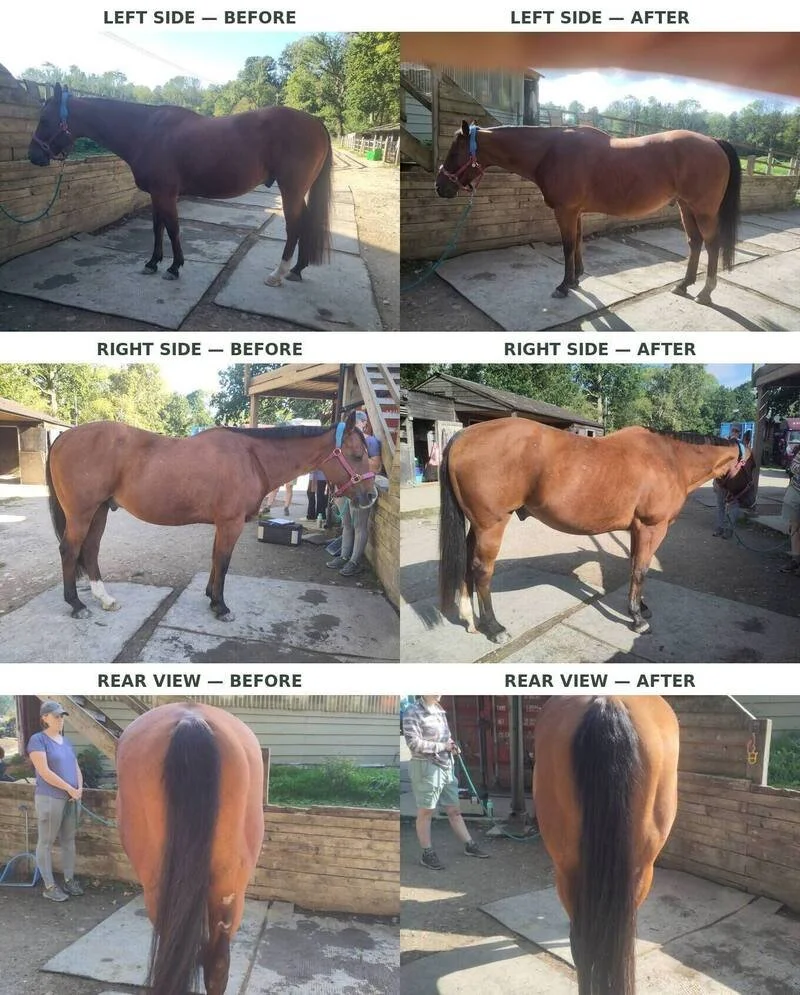
Cody was exceptionally receptive throughout the second treatment. In the photographs taken before and afterwards, his superficial fascial presentation appeared smoother through the neck, shoulder, thoracic wall, back and lumbosacral region. His neck carriage looked softer and more lengthened, and the hindquarters appeared more evenly organised.
Photographs can support clinical observation, but they are not proof of structural realignment. Differences in light, camera angle, stance and foot placement all matter. The most defensible visual change was a reduction in global holding and superficial fascial tension.
What can we conclude?
Cody’s progress is highly encouraging. The timing suggests that osteopathic treatment, veterinary management and thoughtful environmental support may all have contributed. However, one case cannot prove that osteopathy alone produced the improvement, nor does the response identify a single cause for his headshaking.
Headshaking is often multifactorial. Cody’s case shows the value of careful observation, collaboration and reassessing the whole horse rather than focusing only on the head. His owner will continue monitoring for any return of nose rubbing, flicking, facial twitching or larger head-and-neck movements, alongside weather, wind exposure, workload and his response to the ceramic mask.
The next chapter
We will also continue to observe Cody’s right-rein ability, neck side-bending and tendency to load the left shoulder when a forefoot is lifted. Follow-up assessment will consider the cervical, scapular, lumbar, pelvic and hindlimb patterns alongside the duration of benefit from his veterinary hock and sacroiliac treatment.
For now, seeing Cody comfortable during what has historically been his most difficult season is a very positive step—and a reminder that meaningful change can emerge when we listen to the entire horse.
This case study describes one horse’s individual response and is shared for educational purposes. Headshaking can have serious and varied causes. Veterinary assessment should always form part of the investigation, and results from any treatment cannot be guaranteed.